01
The Operational Breakdown
- 01
Outdated Paper Handover Briefings: Shift sheets pinned to breakroom boards become obsolete the moment weather, air traffic control delays, or aircraft tail swaps occur.
- 02
Verbal Gate Changes: Gate and departure changes are passed down by word of mouth, leaving incoming shift staff operating on whatever details were remembered.
- 03
Sequential, Lagging Notifications: An operational disruption reaches ground handling, gate agents, catering, and fueling one after another rather than simultaneously.
- 04
Procedural Drift Across Stations: Outlying regional stations and transit depots gradually develop their own localized turnaround habits without central oversight.
02
How Tawasol Solves It
Scroll the table to read all columns
| Operational Problem | What Tawasol Does | The Functional Result |
|---|
| Outdated Paper Briefings | Shift briefings delivered via Shawts to on-duty personnel devices using high-priority push alerts. | Staff review the active briefing on their smartphones during handover rounds. |
|---|
| Verbal Handover Drift | Structured, written operational updates pushed directly to affected functional units and groups. | Every operational adjustment is logged and reaches incoming shifts exactly as authored. |
|---|
| Sequential Notifications | A single Shawt targets all affected operating units—ramp, gates, fueling, and dispatch—at the same time. | All operational departments respond in lockstep, eliminating tarmac bottlenecks. |
|---|
| Procedural Drift | Dedicated units for each airport or station paired with standard operating procedures hosted in the central Library. | Every terminal and station operates from the identical operational standard. |
|---|
03
Case Studies in Practice
01↗
Scenario A: Last-Minute Gate and Remote Stand Reassignment
- The Role
- Ground Operations Duty Manager.
- The Situation
- A major air traffic delay causes a stand clash, forcing an arriving wide-body aircraft to move from an aerobridge gate to a remote tarmac stand.
- The Action
- He pushes an operational Shawt to that terminal's ground handling, passenger busing, and gate teams prior to the shift handover.
- The Outcome
- Staff review the reassignment on their phones while the paper sheet on the crew-room wall is already out of date. Bus drivers position at the remote stand, baggage tugs redirect, and team leads acknowledge receipt in the operations group.
02↗
Scenario B: Revised Airside Aircraft Turnaround Procedure
- The Role
- Aviation Safety and Compliance Director.
- The Situation
- A revised pushback and wing-walker safety procedure takes effect across all airport stations immediately.
- The Action
- The procedure uploads into the Library and deploys via a Shawt to every airport operational unit.
- The Outcome
- Questions are submitted and resolved in the comments section. The director provides a single answer for all stations, and the distribution log remains archived for civil aviation authority audits.
04
Comprehensive Sector Capabilities
- 01
Terminal and Function Targeting: Ground handlers receive notices meant for airside operations, while passenger service agents receive gate and ticketing notices without cross-chatter.
- 02
Direct Mobile Roster Updates: Schedule revisions, overtime call-outs, and shift coverage adjustments reach staff directly on their mobile devices without relying on paper rosters.
- 03
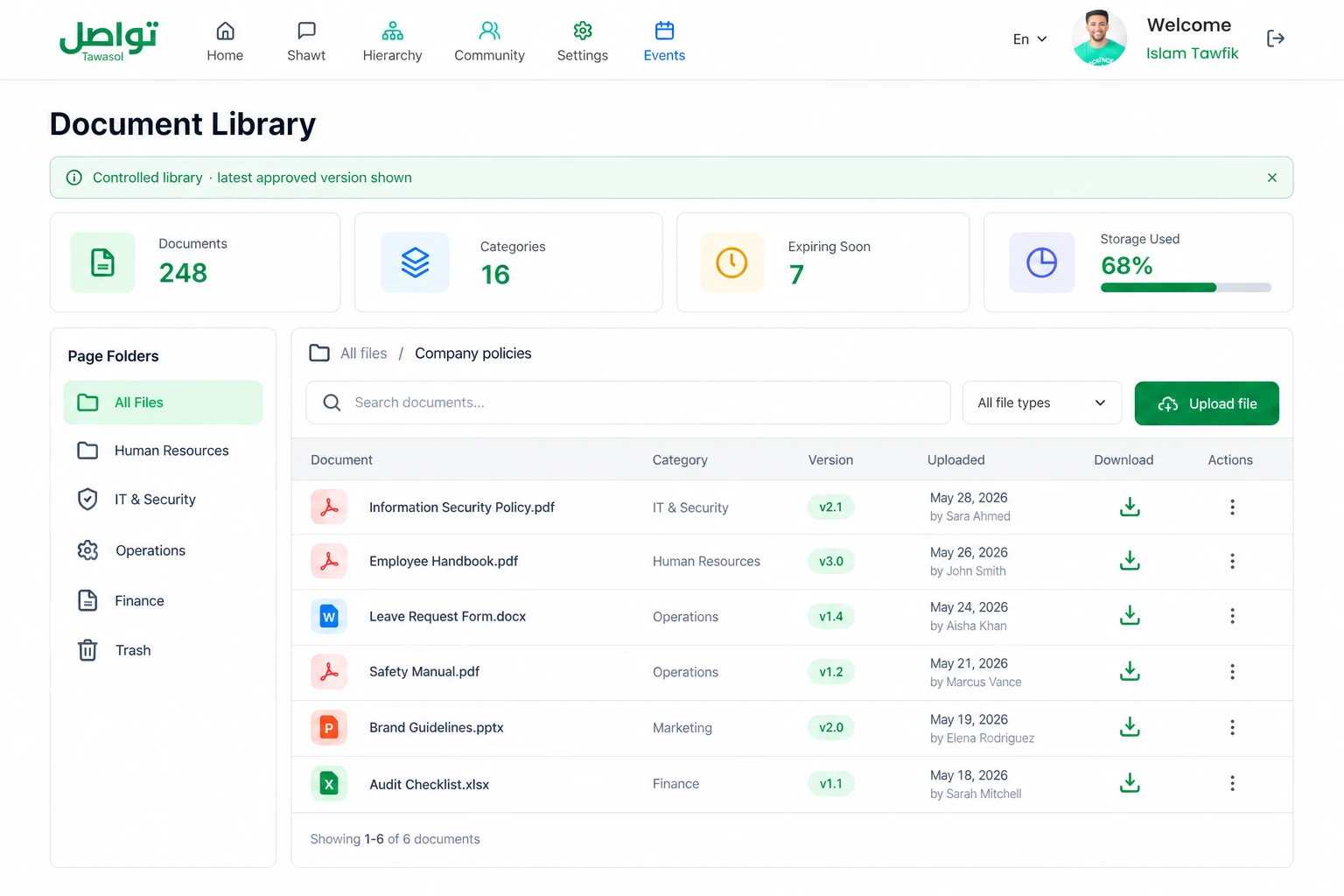
Airside Digital Technical Manuals: Aircraft turnaround checklists, dangerous goods handling sheets, and emergency procedures sit in the Library, accessible right out on the apron.
- 04
Recurrent Staff Training Cycles: Mandatory safety and airside driving courses run under Events; staff register through the app, and training leads verify qualifications.
- 05
Incident Reporting to Duty Managers: Airside ground equipment damage or security events are reported with instant photo proof directly inside the safety group.
05
Measurable Value
- ↗
Day-to-day: Every operational shift begins from verified, current information, and duty managers stop repeating identical briefings team by team.
- ↗
Over time: Operating consistency holds firm across stations and shifts, while institutional knowledge survives high turnover instead of resetting with every new roster.
06
Frequently Asked Questions
Can a shift briefing target a single terminal or job role?
Yes. Senders determine the precise audience—an entire terminal, a specific department, or a single shift team.
Can deskless airside personnel use Tawasol?
Yes. Field personnel use the mobile application, signing in with their assigned Employee ID number.
Can ground operations manuals be accessed out on the airport apron?
Yes. Manuals, ground checklists, and emergency procedures sit inside the Library and open directly on mobile devices.
Does Tawasol support multiple airport stations or transit hubs?
Yes. Each airport station or railway depot is configured as a unit within a single master organizational tree.
Can Tawasol deploy on private enterprise servers?
Yes. On-premise installation is standard, ensuring the platform runs entirely within your organization’s private server infrastructure.