01
The Operational Breakdown
- 01
Transmission Latency: A critical circular takes days to filter through four bureaucratic tiers before reaching frontline administrative desks.
- 02
Message Degradation: Intermediary managers paraphrase policies in their own words, leaving regional offices operating on interpretations leadership never approved.
- 03
No Audit Trail: When an office fails to implement a mandate, executive leadership cannot trace where the distribution chain stalled.
- 04
Exposure and Leaks: High-level circulars end up on personal smartphones, get shared as screenshots in consumer chat groups, and live inside tools beyond state oversight.
02
How Tawasol Solves It
Scroll the table to read all columns
| Operational Problem | What Tawasol Does | The Functional Result |
|---|
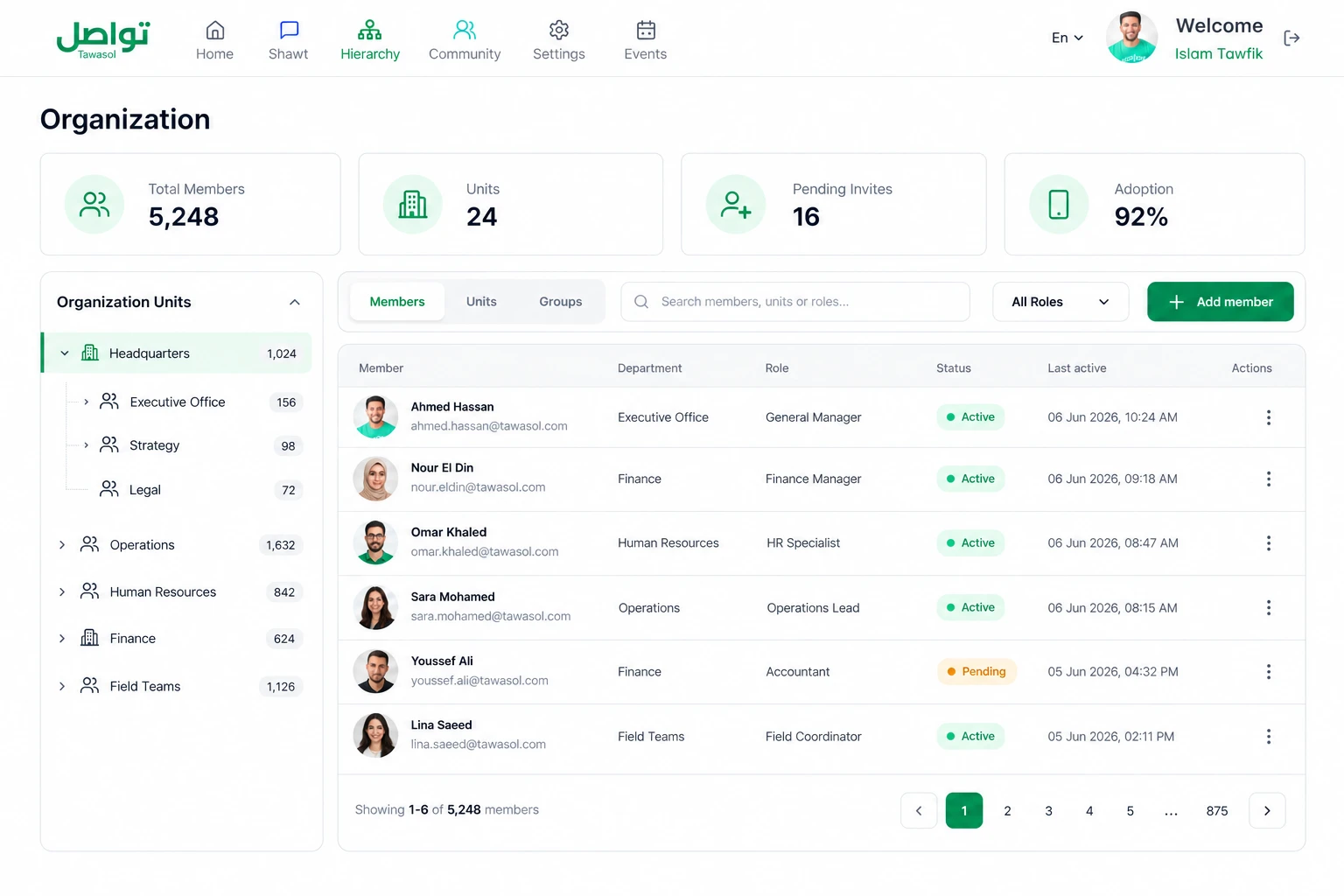
| Transmission Latency | Official notices (Shawts) publish directly to designated target units selected from an Organization Tree that mirrors the civil service chart. Instant push alerts deliver them immediately. | Regional offices read the directive the morning it is issued. |
|---|
| Message Degradation | The original, approved directive travels as an attachment pulled directly from the secure digital Library. | Every branch reviews the identical, unedited ministerial wording. |
|---|
| No Audit Trail | Every communication is centrally logged, time-stamped, and open to internal compliance audits, tying every Shawt to its targeted recipients. | Leadership can conclusively prove what was dispatched, to whom, and at what second. |
|---|
| Exposure and Leaks | Deploys on-premise inside state data centers. Features AES-256 and TLS encryption, hardware-level screenshot and screen-recording prevention, dynamic user-identifying watermarks, and granular download controls. | Protected files never leave sovereign control, and external camera photographs trace directly back to the individual viewer. |
|---|
03
Case Studies in Practice
01↗
Scenario A: Direct Ministerial Cascade
- The Role
- Director of Corporate Communications at a central ministry.
- The Situation
- A revised inspection regulation takes effect across field offices in three distinct administrative regions starting Sunday morning.
- The Action
- From Tawasol’s Organizational Tree, she selects the three regional directorates. She attaches the approved procedural document directly from the Library (configured as view-only) and publishes a single Shawt.
- The Outcome
- Regional staff receive the alert on their devices before doors open. Field inspectors leave questions as comments directly under the Shawt. The legal team answers once where every office can see the clarification, eliminating dozens of identical phone calls and logging an indisputable record of compliance.
02↗
Scenario B: Sovereign On-Premise Governance
- The Role
- Ministry Chief Information Technology Officer.
- The Situation
- State cybersecurity auditors and state procurement officers demand verification of data residency, encryption standards, and user access parameters.
- The Action
- Tawasol is installed within the ministry’s dedicated server facility. Account roles map directly to Active Directory. Content remains encrypted in transit and at rest. Screenshot captures are blocked at the OS level, dynamic watermarks overlay all open files, and each Library entry is set to view-only.
- The Outcome
- The entire platform functions with zero reliance on foreign cloud hosting, passing sovereign security evaluations without exception.
04
Comprehensive Sector Capabilities
- 01
Emergency and Continuity Broadcasts: Dispatch urgent civil defense, weather, or continuity notices to every employee or specific provinces via high-priority push notifications—without requiring staff to have corporate email on their personal devices.
- 02
Searchable Regulatory Repository: Forms, procedural templates, and executive regulations sit organized by topic within the Library, accessible via mobile in view-only format where sensitivity dictates.
- 03
Inter-Directorate Working Files: Shared Groups bring multiple departments together on joint initiatives without opening either department’s internal channels to the other.
- 04
Official Seminars and Training: Post workshops and mandatory briefings under Events. Personnel register directly through the application, and administrators approve attendees individually.
- 05
Field Inspections and Audits: The Tracking engine assigns inspection routes to officers, tracks their progress across an interactive live map, and receives field reports complete with geo-stamped photos and location metrics inside the platform.
05
Measurable Value
- ↗
Day-to-day: Field units execute directives using approved phrasing on the exact day of release. Classified circulars remain locked inside the platform.
- ↗
Over time: Internal administrative communication transforms from an informal chain of email forwards into a searchable, auditable institutional archive under total sovereign custody.
06
Frequently Asked Questions
What is Tawasol?
Tawasol is an enterprise communication platform created by IT-Blocks. It integrates announcements (Shawts), group messaging, a document library, event workflows, internal ticketing, and mobile workforce tracking into a single white-labeled app for iOS and Android.
Can Tawasol be hosted exclusively on our private servers?
Yes. Tawasol installs on-premise inside your own server architecture or within certified national sovereign clouds, ensuring total administrative custody.
Does the platform synchronize with Active Directory?
Yes. Accounts, permissions, and department memberships sync with Active Directory, mapping system rights directly to official job roles.
How are classified files shielded from unauthorized sharing?
Through AES-256 data-at-rest encryption, TLS data-in-transit protection, native screenshot and screen-recording prevention, dynamic user-stamped watermarks, and view-only settings that prevent local downloads.
Can field workers without a government email address use Tawasol?
Yes. Workers access the mobile application by logging in with their civil National ID or Employee ID.
Can communications between distinct directorates remain segregated?
Yes. Granular, role-based controls keep directorates completely isolated. Dedicated Groups allow cross-departmental collaboration on specific projects without exposing internal chatter.