01
The Operational Breakdown
- 01
Fragmented Chats Per Property: Every building team sets up informal chat groups that central management cannot monitor or audit.
- 02
Late Problem Escalation: Head office discovers equipment failures only after a problem escalates into an official tenant complaint.
- 03
Excessive Contractor Access: External maintenance vendors added to general team channels see operational discussions and tenant data well outside their scope.
- 04
Paper-Bound Compliance Files: Fire safety certificates, lift inspection logs, and warranty binders sit locked in office filing cabinets instead of being accessible during inspections.
02
How Tawasol Solves It
Scroll the table to read all columns
| Operational Problem | What Tawasol Does | The Functional Result |
|---|
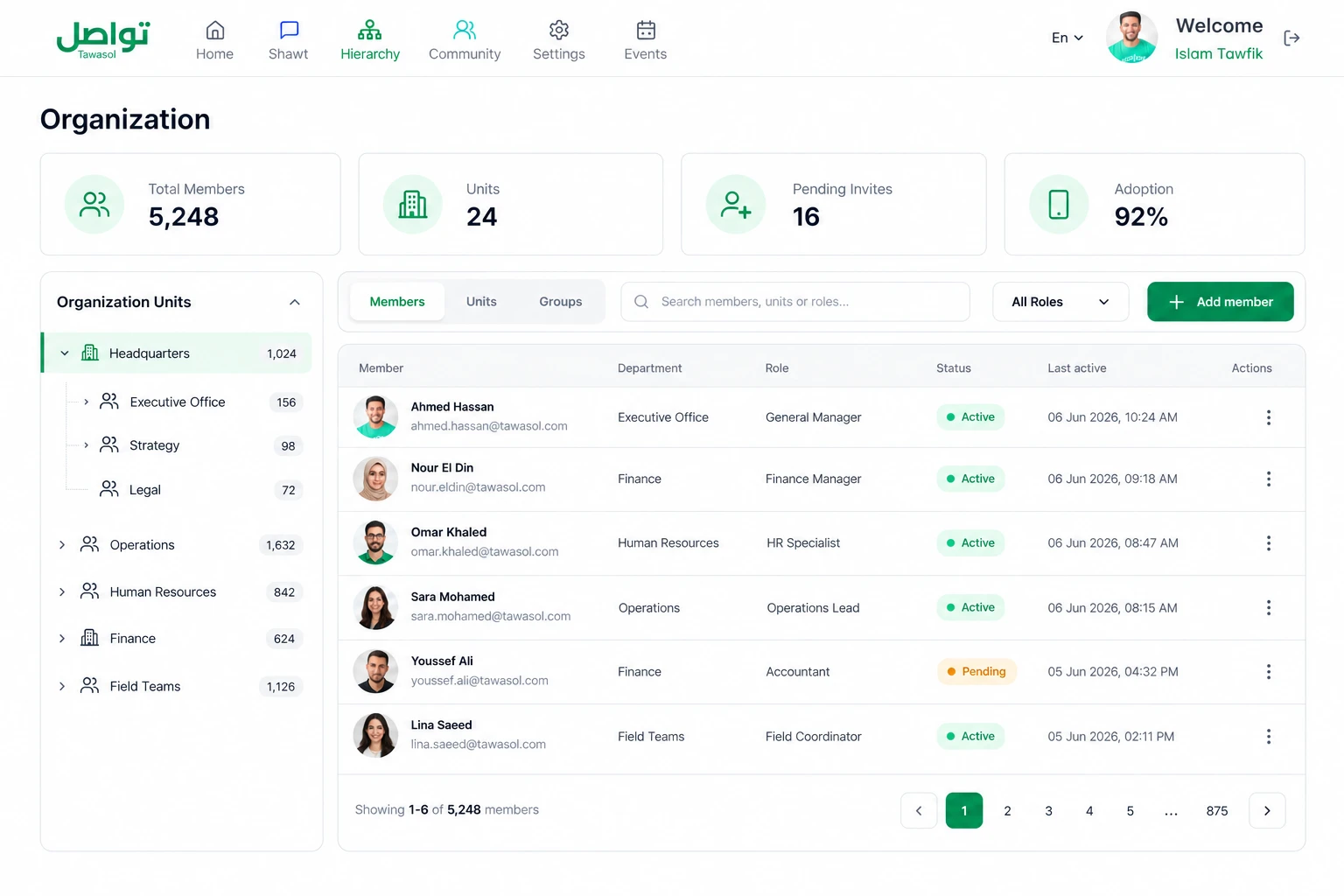
| Fragmented Chats | Dedicated units for each property paired with functional groups inside a unified platform. | Central property management monitors communication across the entire asset portfolio from one screen. |
|---|
| Late Problem Escalation | On-site technicians post equipment faults with photos, while the Tracking module captures geo-located reports. | Decision-makers identify and resolve mechanical issues while they are small and manageable. |
|---|
| Excessive Contractor Access | Isolated contractor groups configured with role-based access limits. | Service vendors coordinate their trade tasks without gaining visibility into the rest of the building's operations. |
|---|
| Paper-Bound Files | Equipment manuals, maintenance logs, and compliance certificates stored in the searchable mobile Library. | Technical documents are instantly accessible to engineers on the roof or in plant rooms. |
|---|
03
Case Studies in Practice
01↗
Scenario A: Commercial Tower Air Conditioning Failure
- The Role
- Multi-Site Facilities Manager.
- The Situation
- A primary central cooling compressor fails inside a commercial tower during business hours.
- The Action
- The building technician photographs the failed pump and diagnostic panel, posting the issue to that property's maintenance channel.
- The Outcome
- The manager assesses the failure remotely and authorizes emergency repair in the chat thread. Tenant relations—active in the same channel—receives immediate updates and informs corporate tenants before complaints escalate.
02↗
Scenario B: Portfolio-Wide Access Protocol Update
- The Role
- Director of Property Operations.
- The Situation
- A revised building access and physical security protocol takes effect across all properties in the portfolio.
- The Action
- The procedure uploads into the Library and deploys via a Shawt across all property units.
- The Outcome
- Building supervisors post questions as comments, allowing operations leadership to clarify points once for the entire portfolio while preserving an auditable distribution log.
04
Comprehensive Sector Capabilities
- 01
Advance Notice of Planned Works: Post scheduled elevator servicing, power shutdowns, or facade cleaning with dates and times to keep site teams and tenant coordinators aligned.
- 02
Digital Guard Shift Handovers: Security teams, day concierges, and facilities engineers transfer notes through a shared group rather than handwritten, unread logbooks.
- 03
Building-Specific Emergency Broadcasts: Deploy evacuation plans or severe weather alerts exclusively to the occupants and staff of an individual property.
- 04
Rapid Onboarding for New Properties: New acquisitions are provisioned as distinct units, their teams are onboarded via Excel import, and they immediately inherit the portfolio's standard operating manuals.
- 05
Maintenance Request Management: Route tenant and equipment repair requests directly through Ticketing to the responsible engineering team.
05
Measurable Value
- ↗
Day-to-day: On-site teams report mechanical issues with visual evidence, and central management tracks property issues in real time.
- ↗
Over time: Maintenance standards remain uniform across properties regardless of contractor changes, while adding a new asset requires provisioning a unit rather than inventing a new workflow.
06
Frequently Asked Questions
Can each building maintain its own isolated communication channel?
Yes. Each building operates as a dedicated unit with distinct sub-groups organized by function.
Can outside contractors be restricted to limited operational channels?
Yes. Role-based contractor groups ensure third-party vendors see only communications relevant to their immediate scope of work.
Can facilities technicians submit fault reports with photo evidence?
Yes. Channels support high-resolution photos, voice memos, and documents, while the Tracking engine captures geo-tagged reports.
Are technical manuals and compliance certificates accessible on site?
Yes. All procedural documents, checklists, and warranty records sit in the Library, accessible via mobile devices.
How is a newly acquired building added to the system?
It is provisioned as a new organizational unit, and its on-site personnel are imported individually or via bulk Excel upload.