01
The Operational Breakdown
- 01
Outages Managed via Phone Calls: Emergency field coordination relies on phone calls, leaving dispatchers with no written audit log of work instructions.
- 02
Call Centers Out of Sync: Customer support agents give subscribers outdated restoration times while repair crews are encountering different conditions on site.
- 03
Unrecorded Field Modifications: Emergency circuit diversions or line adjustments agreed on site disappear into unrecorded phone conversations, leaving schematics out of date.
- 04
Documentation Trapped at the Depot: Equipment manuals, sub-station schematics, and high-voltage switching procedures sit back at the depot rather than in the field.
02
How Tawasol Solves It
Scroll the table to read all columns
| Operational Problem | What Tawasol Does | The Functional Result |
|---|
| Outages Managed via Calls | Shawts sent to affected repair units paired with Tracking tasks carrying real-time status flags. | Technicians receive written work orders on their phones, and central operations tracks repair progress live. |
|---|
| Call Centers Out of Sync | A single Shawt targets regional line crews and the regional telephone support center simultaneously. | What telephone agents tell subscribers matches what line technicians are executing on site. |
|---|
| Unrecorded Field Modifications | Voice memos, high-resolution photos, and geo-located reports uploaded directly to the operational group. | Every technical variation is logged against the work order in the central repository. |
|---|
| Documentation at Depot | Technical specifications and switching manuals hosted in the secure Library, reachable via mobile devices. | Field engineers review network documentation right at the equipment cabinet or pole. |
|---|
03
Case Studies in Practice
01↗
Scenario A: Multi-District Grid Outage
- The Role
- Network Operations Center (NOC) Lead.
- The Situation
- A major cable fault cuts connectivity to thousands of subscribers across two municipal districts during peak business hours.
- The Action
- He assigns repair tickets to regional line crews via the Tracking engine and sends a simultaneous Shawt to field units and the regional call center.
- The Outcome
- Telephone support agents quote accurate restoration timelines matching field progress. As technicians splice and test lines, task statuses update live on his dispatch console.
02↗
Scenario B: Site Conditions Conflict with Work Order
- The Role
- Senior Field Line Engineer.
- The Situation
- On-site inspection reveals that an underground conduit is flooded and collapsed, requiring an alternate routing not covered by the original work order.
- The Action
- He captures photos of the damaged conduit and records a voice memo explaining the required diversion inside the operations group.
- The Outcome
- The engineering lead reviews the visual evidence, approves the variation inside the chat thread, and saves the verified modification against the job's asset record.
04
Comprehensive Sector Capabilities
- 01
Targeted Crew Communications: Route operational notices to a single line crew, a geographic district, or the entire field operations workforce.
- 02
Pre-Work Safety Briefings: Switching protocols, high-voltage safety rules, and permit-to-work checklists sit in the Library for mandatory review before work begins.
- 03
Emergency Shift Roster Changes: Broadcast emergency call-outs and shift coverage updates directly to off-duty technicians' handsets.
- 04
Technical Training Seminars: Publish equipment certifications under Events; technicians register in-app, and training leads confirm qualifications.
- 05
Rapid Escalation Channels: Dedicated emergency channels connect frontline technicians to network safety controllers for immediate hazard response.
05
Measurable Value
- ↗
Day-to-day: Field technicians and call center agents operate from the same information, while repair orders arrive in writing rather than over noisy phone calls.
- ↗
Over time: Major incident response becomes an auditable, repeatable workflow, while specialized engineering knowledge stays preserved in the central Library.
06
Frequently Asked Questions
Can Tawasol coordinate field crews and telephone call centers simultaneously?
Yes. A single Shawt can target field engineering units and customer service squads at the exact same moment.
Can Tawasol track the geographic location of field teams?
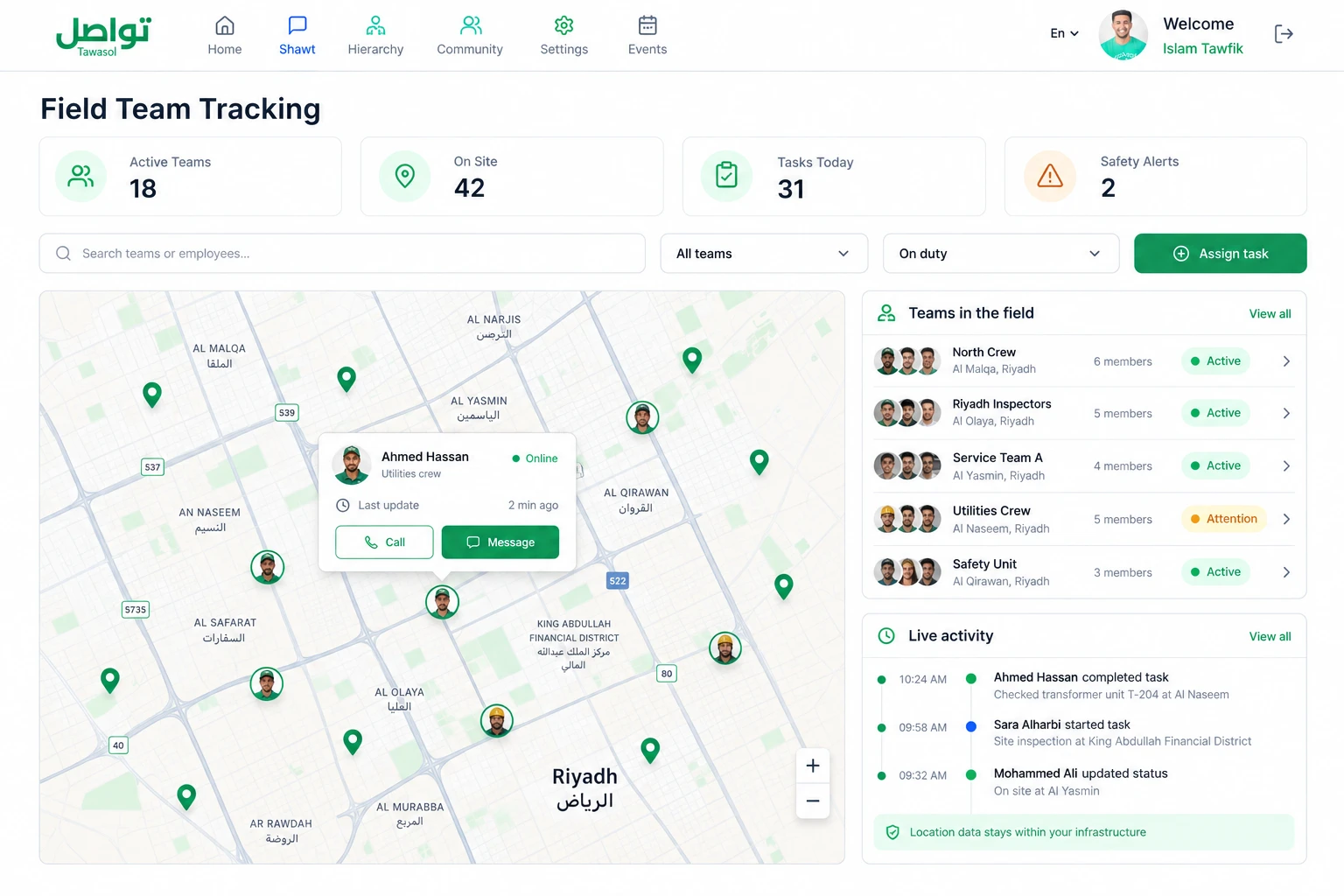
Yes. The Tracking engine shows crew locations across an interactive map and updates task progress in real time.
Can technicians submit reports directly from the work site?
Yes. Field workers submit reports complete with high-resolution photos, location stamps, and voice recordings.
Can an advisory be directed to a single crew?
Yes. Senders choose the exact audience: an entire division, a specific crew, or named individuals.
Can Tawasol deploy on private enterprise servers?
Yes. The platform deploys on-premise within your organization's private server infrastructure.