01
The Operational Breakdown
- 01
Fragmented Information Channels: Academic announcements are spread across institutional email, physical boards, personal chat groups, and social media channels.
- 02
Campus-Wide Broadcast Noise: Notices relevant only to a single degree cohort get sent to the entire student body, conditioning students to ignore university communications.
- 03
Manual Event Logistics: Registration for orientation sessions, guest lectures, and student clubs is tracked manually on spreadsheets.
- 04
Unmonitored Shadow Channels: Unofficial student-run chat groups become the default source for campus news, accelerating the spread of rumors and bad information.
02
How Tawasol Solves It
Scroll the table to read all columns
| Operational Problem | What Tawasol Does | The Functional Result |
|---|
| Fragmented Channels | A single, university-branded app for campus notices, academic documents, events, and official messaging. | Students always know the single place to look for verified institutional information. |
|---|
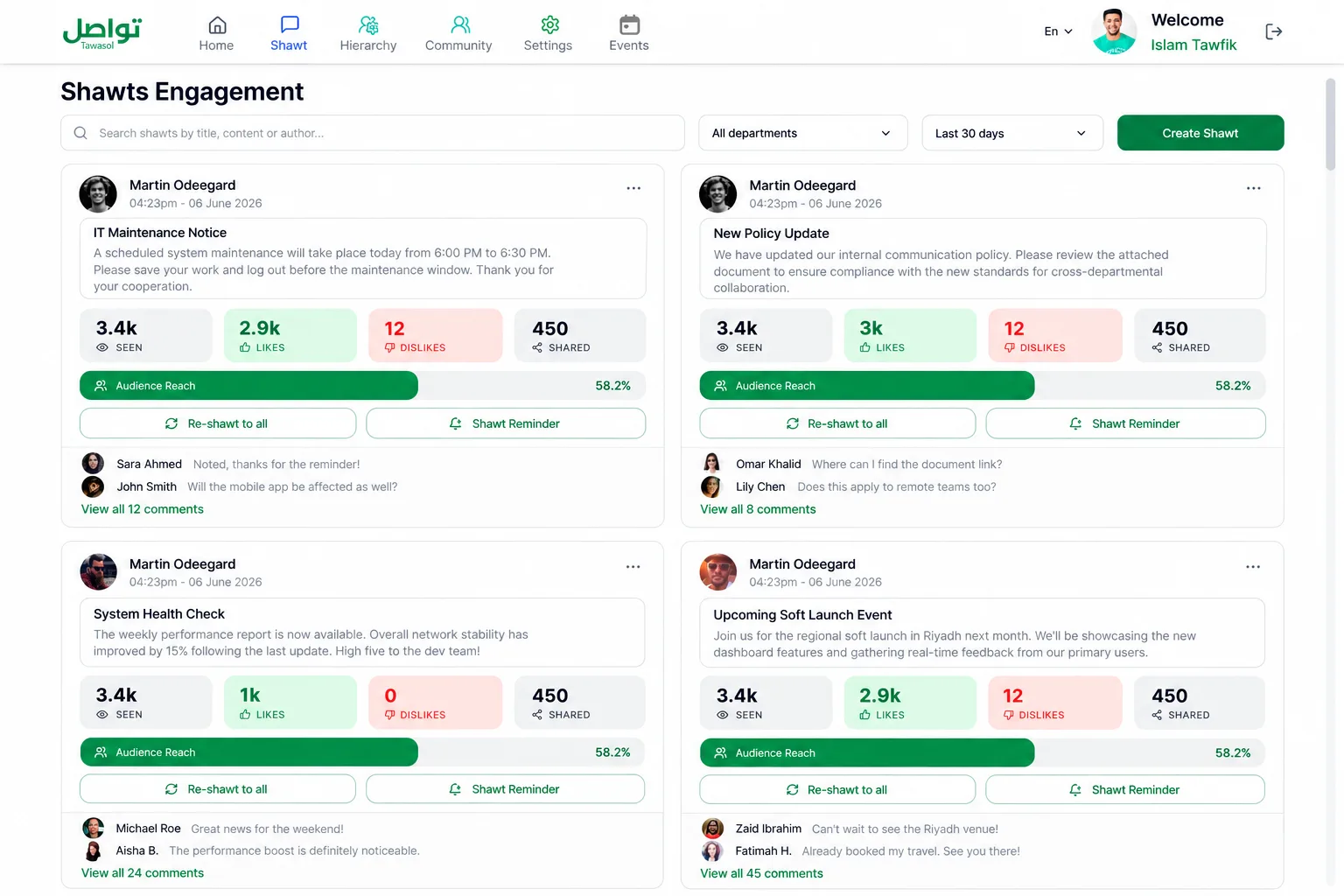
| Broadcast Noise | Shawts target specific colleges, academic departments, graduating years, or designated student groups. | Students receive only what applies to their studies, so they pay attention to what arrives. |
|---|
| Manual Event Spreadsheets | Events engine with integrated in-app registration and administrative approval workflows. | Attendance figures and seat caps are confirmed days before the event takes place. |
|---|
| Shadow Channels | An official Community space monitored through administrative moderation controls. | Students gain an approved, university-governed digital forum for campus dialogue. |
|---|
03
Case Studies in Practice
01↗
Scenario A: Urgent Examination Timetable Change
- The Role
- College Registrar.
- The Situation
- A scheduling conflict forces a revised exam timetable for third-year mechanical engineering students eight days before the first paper.
- The Action
- She issues the updated schedule exclusively to the third-year mechanical engineering cohort group. The new timetable overwrites the old version in the Library, and students receive a priority push notification.
- The Outcome
- The broader university student body is not disturbed, students have the verified timetable on their phones, and no one arrives at the hall using an outdated schedule.
02↗
Scenario B: New Student Orientation Registration
- The Role
- Student Activities Coordinator.
- The Situation
- Organizing departmental orientation briefings for incoming freshmen across multiple lecture halls.
- The Action
- Each orientation session is created as an Event with dates, seat limits, and agendas. Freshmen register through the app; requests queue as pending until approved on her administrative console.
- The Outcome
- Attendance lists are finalized automatically, capacity limits are maintained, and registered students receive automated reminders.
04
Comprehensive Sector Capabilities
- 01
Timely Academic Deadlines: Course registration windows, tuition deadlines, and drop/add dates reach students via priority push notifications.
- 02
Central Academic Document Repository: Course syllabi, faculty rules, graduation forms, and degree roadmaps sit organized by topic within a searchable Library.
- 03
Segregated Faculty-Only Channels: Teaching faculty and administrative staff retain private departmental units and working groups for internal academic matters.
- 04
Campus Safety and Closure Alerts: Severe weather alerts, facilities outages, or security warnings deploy to specific campuses or the entire student body in seconds.
- 05
Login Mapped to University Records: The login screen authenticates against Student ID or Faculty ID, matching the identifiers already in the registrar's database.
05
Measurable Value
- ↗
Day-to-day: Students receive verified academic notices in one place, while coordinators communicate directly with specific academic cohorts.
- ↗
Over time: Institutional communication becomes a repeatable process, establishing a multi-year archive of official university notices.
06
Frequently Asked Questions
Can announcements target a single college or academic cohort?
Yes. Every Shawt can be restricted to an individual college, academic year, degree track, or student group.
Can students sign in using their standard Student ID?
Yes. The login field can be labeled to authenticate against Student IDs, Civil IDs, or existing campus database credentials.
How does event ticketing and registration work?
Students register for campus Events directly in the app. Organizers can review pending applicants, enforce attendance caps, and approve places from their console.
Can the university oversee and moderate student discussions?
Yes. The Community module includes administrative moderation tools, allowing authorized staff to review, flag, or remove unacceptable posts.
Can the app carry our university’s name and crest?
Yes. Tawasol deploys fully white-labeled under your institution's name and brand identity on iOS and Android.