
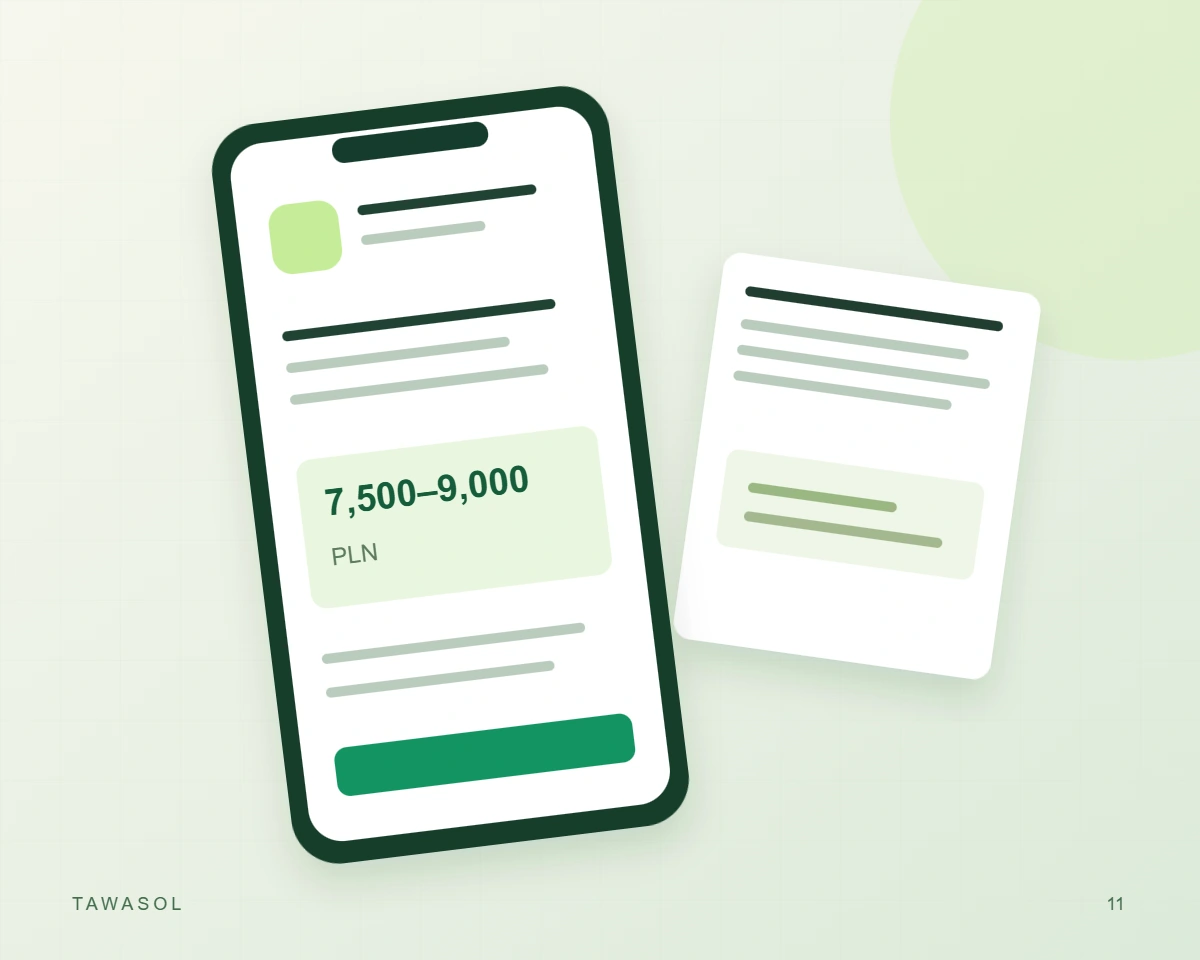
On Monday the company posted a job ad with a salary range. By Wednesday, a customer service specialist with three years’ service had found out that a new hire could start above him.
On Monday morning, the recruitment team published an ad for a customer service specialist.
The new rules require candidates to receive pay information during recruitment, and the team chose to put it in the ad itself: 7,500 to 9,000 PLN gross a month. The ad was clear and compliant.
Tomasz has done that exact job for three years. He earns 7,200 PLN.
By Monday evening, someone had shared the ad in the team’s group chat. By Tuesday, three people had asked their manager, Kasia, whether the new hire would earn more than them. Kasia didn’t know how the range had been set, so she told them she would find out.
By Wednesday, the version going round the team was simple: the company pays newcomers more than the people who built the department. Nobody from HR had said a word, because nobody in HR knew the conversation was happening.
Two of Tomasz’s colleagues updated their CVs that week.
01What does Poland’s pay transparency rule require?
The legal part is straightforward, and the company followed it.
Since 24 December 2025, employers in Poland must give candidates the starting pay or a pay range, either in the job ad or before the interview or contract. Job titles and ads must also be gender-neutral, and employers can’t ask candidates what they earn now or earned before.
Recruitment teams adapted quickly. They updated ads, changed templates and got legal sign-off.
Most organisations didn’t prepare for the obvious consequence. Candidates aren’t the only ones reading a pay range in a public job ad. Every current employee doing the same job reads it too, and it answers a question many of them were never told the answer to: what is this role worth?
02Your employees read your job ads too
For years, many Polish organisations handled pay quietly. People had a rough idea of what colleagues earned, from rumours and comparisons, but nothing official.
Then the company itself starts publishing numbers. Now Tomasz has a range, and he can see exactly where he sits in it: below the bottom.
There may be perfectly good reasons. Maybe the market moved and his pay hasn’t been reviewed yet. Maybe the range includes a bonus element he already receives separately. Maybe a review is already planned for next quarter.
None of that matters if nobody tells him. Without an explanation, people build their own, and the version they build is rarely generous.
03The manager is the first person asked, and the last to know
Look at Kasia’s position. Her team came to her because she’s their manager, which is exactly right. She had nothing to tell them, because recruitment, HR and finance set the pay range between them, and nobody thought to brief the managers whose teams would see it.
So the most trusted person in the conversation was the least informed. Her honest “I’ll find out” sounded, to a worried team, like confirmation that something was being hidden.
This is the same internal communication failure as any cascade, with higher stakes. A message about pay that reaches people through a forwarded job ad and an unprepared manager will be read in the worst possible way.
04How do you explain pay before the ad does?
No organisation needs to publish individual salaries. The law doesn’t ask for it, and most employees don’t want it. What they want is to understand the logic.
Start with a plain-language explanation of how pay is set in your organisation: which factors move pay, such as skills, experience, responsibility and performance, and how often pay is reviewed. Put it in Tawasol’s library as one current document, so everyone reads the same version instead of a summary of a summary.
Full pay bands for each role are a different matter. They belong with the managers who need them to answer questions, not in a document the whole company can open. For any sensitive file you do keep in the library, its security status controls whether it can be downloaded, and confidential files carry a watermark with the ID of the person who opened them.
Then announce it. Publish first to a group of the managers concerned, a few days ahead, so Kasia knows what’s coming and can answer her team. Then publish to the relevant units: what has changed in how we advertise roles, why ranges now appear in our job ads, and where to read how pay is set here.
05Give questions somewhere to go
Once pay is discussed openly, questions follow. Some are general, like how often salaries are reviewed. Those belong under the announcement, answered once in the comments so everyone reads the same answer.
Others are personal, like why someone sits below the range. Those should never be discussed in a public thread. The announcement itself should say how to raise an individual question, for example through a direct, secure chat with HR in the app, and who will respond.
That way, Tomasz’s question reaches someone who can answer it, instead of circulating in the team group until it hardens into a grievance.
06The bigger rules are still coming
The December rules cover recruitment only. The rest of the EU Pay Transparency Directive was due in national law by 7 June 2026. Poland missed that deadline, and the second law is still a draft.
The latest draft, published in May 2026, includes job evaluation against set criteria, gender pay gap reporting for larger employers and a right for employees to request pay information, with a 30-day deadline for the answer. It would take effect six months after publication, and it proposes June 2027 for the first reports from employers with 150 or more staff.
Details and dates may still change, so check the current status before planning around them. The direction won’t change: more pay information, more questions and more need to explain decisions clearly. Organisations that build the habit of explaining pay now, while the stakes are lower, will find the next stage much easier.
07Monday, with the explanation in place
The week before the ad, HR published a short document in the library explaining how pay is set: the factors that matter, how ranges are built and when reviews happen. Managers received it in their own group first, along with the new ad and the reasoning behind its range. Kasia read it on Wednesday and saw that Tomasz’s review was already scheduled for the next quarter.
On Monday, the ad goes live. An announcement goes to customer service and the other affected units: from now on, our job ads include pay ranges, here’s why, and here’s where to read how pay is set.
On Monday evening, someone still shares the ad in the team chat. This time, two people reply with the link to the document. Tomasz sends HR a private message asking where he sits. By Thursday, he has a meeting date and an honest explanation: the market moved faster than his last review, and the next one is in eight weeks.
Nobody updates their CV that week.
- job ad
- team chat
- unbriefed manager
- rumour
- CVs updated.
- pay document in library
- managers’ group
- ad + announcement
- private question to HR
- meeting date.
08What your next job ad will say
Your recruitment team will publish another ad soon, and may choose to include a pay range. The question is whether your current employees will read it alongside an explanation, or instead of one.
The range is a number. The explanation decides how people feel about it.
If your next ad is close to going live, talk to us first. Bring the ad and the pay explanation behind it, or tell us there isn’t one yet. We’ll plan who needs to hear what before it’s published: managers first, then teams, and where individual questions will go.
Prepare your next job ad with us ↗Tawasol. Your team, connected.
Frequently asked questions
How does pay transparency affect internal communication?
Once pay ranges are public, employees compare their own pay with them, so organisations need to explain how pay is set, brief managers first and give personal questions a private route.
What does Poland’s pay transparency rule require from employers?
Since 24 December 2025, employers must give candidates the starting pay or a pay range, in the job ad or before the interview or contract, and can’t ask about their current or past pay.
Why does pay transparency affect current employees?
Employees in the same role read public job ads and compare their own pay with the range.
Who should hear about a new pay range first?
The managers of affected teams, a few days ahead, followed by the teams, with a private route for personal questions.