
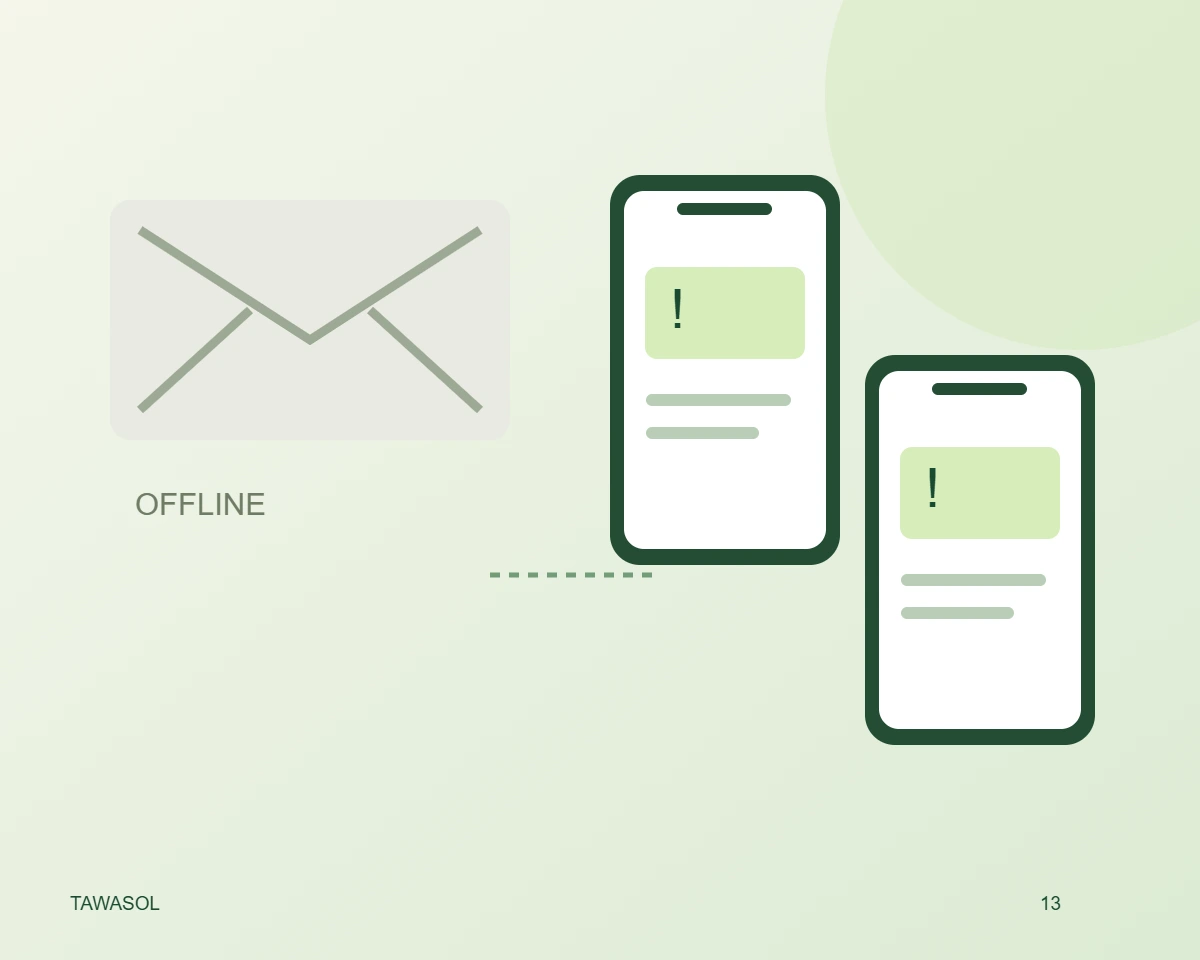
It's 7:40 on a Monday. Ransomware has encrypted the mail server. The IT team is isolating systems. Two thousand employees are about to log in to machines they shouldn't touch. Nobody can send them an email to say so.
NIS2 anticipated this moment. Among the minimum security measures in Article 21(2), point (j) requires, where appropriate, multi-factor or continuous authentication, secured voice, video and text communications, and secured emergency communication systems within the entity. In Polish: zabezpieczonych połączeń głosowych, tekstowych i wideo oraz zabezpieczonych systemów łączności wewnątrz podmiotu w sytuacjach nadzwyczajnych.
01Why your everyday tools fail in a crisis
Most organisations run crisis communication on the same systems the incident takes down. Email, the intranet, the shared drive with the contact list. An incident response plan that starts with "email all staff" has a single point of failure.
The other default is worse. Managers improvise with personal messaging apps and private phone numbers. Instructions spread unevenly. Some employees never hear. Nothing is recorded.
02What a crisis channel needs
- Reach: every employee, on the phone they carry, including field and frontline staff without corporate email.
- Targeting: different instructions for the IT response team, branch staff and management.
- Two-way contact: staff report what they see; responders talk by voice or video.
- Proof: who received the instruction, and when.
- Independence: the channel shouldn't depend on the system that failed.
03How Tawasol supports Article 21(2)(j)
| Requirement | Tawasol |
|---|---|
| Push emergency instructions to everyone at once | Shawts — instant push notification; built-in crisis management and risk announcement drafting topics |
| Target the right audience | Select by unit, group or individual member |
| Confirm the message landed | Alerts with receipt and read tracking; dashboard shows each member's installation and login status |
| Secured voice, video and text between responders | Chats — one-to-one and group messaging, voice messages, and voice and video calls |
| Staff report from the ground | Ticketing — two-way inquiries with category, location and attachments |
| Emergency procedures always at hand | Library — the crisis playbook on every phone |
On independence, ask the right question. Where your emergency channel runs matters as much as what it does. Walk through how Tawasol would be deployed for your organisation with our team in a demo, and test it against your continuity plan.
04Test it before you need it
Article 21 also requires business continuity and crisis management. Run a drill this quarter. Send a test alert to all staff. Measure how many received it within 15 minutes. That number is your real readiness.
05The first hour, two ways
Take the Monday morning from the opening, as an illustrative timeline.
Without a crisis channel. At 07:40 the mail server is down. By 07:55 the IT manager is calling department heads one by one from a personal phone. At 08:10 a manager posts "don't log in" in a private group chat that covers a third of her team. At 08:30 employees in two branches have already logged in and opened files. At 09:00 nobody can say who was told what, or when.
With a crisis channel. At 07:45 the response lead sends a Shawt to all units: do not log in, wait for instructions. It is drafted from the crisis-management topic and lands as a push notification on every phone. At 07:50 a second message goes only to the IT response group, with a voice call to coordinate. By 08:05 the dashboard shows who has received the alert. Supervisors call the few who haven't. Field staff report what they see through Ticketing, with location attached. At 09:00 the response lead has a timeline of every instruction sent.
The incident is the same in both versions. In the second, the response team spends the first hour on the response.
06A 30-day plan for Article 21(2)(j)
Week 1 — Roles and groups. Name the response team, the communication owner, a deputy, and the unit heads who relay instructions. Set them up as groups that don't follow the normal reporting line.
Week 2 — Templates and playbook. Pre-write the first three messages you'll need: stop, wait, and all-clear. Put the full crisis playbook in a library that everyone can open from their phone.
Week 3 — Enrolment. Check that every employee has installed the app and logged in. Close the gaps unit by unit, starting with field and shift teams.
Week 4 — Drill. Send a test alert to all staff. Measure reach at 15 minutes. Run a voice or video call with the response group. Write down what slowed you down and fix it.
Then add the drill to your business continuity testing calendar, so it happens again without anyone having to remember.
FAQ
Is emergency communication mandatory under NIS2?
Article 21(2)(j) requires it "where appropriate", based on your risk assessment. Most entities with large or distributed workforces will struggle to justify leaving it out.
Can we use a consumer messaging app as our emergency channel?
Capabilities vary by service and configuration. Assess organisation-managed membership, audience targeting, records and off-boarding. Removing a member does not delete history or files already saved on their device.
Does Tawasol replace our incident response tools?
No. It is the communication layer that tells your people what the response team needs them to do.
Point (j) also mentions multi-factor authentication. Does Tawasol cover that?
Authentication is an access-control measure your IT team manages across systems. Tawasol connects with Azure Active Directory, so it can follow your organisation's identity setup. Confirm the details for your environment in a demo.
How often should we test emergency communication?
NIS2 doesn't set a frequency. Align the test with your business continuity and crisis management exercises, and repeat it whenever your structure or response team changes.
How does Article 21 apply in Poland?
Through the amended KSC act, which brings the NIS2 risk-management measures into Polish law. For certain digital-sector entities, EU Implementing Regulation 2024/2690 sets out the technical and methodological requirements in more detail.
Sources
This article is general information, not legal advice. Confirm your obligations with your legal or compliance team.